Ibict has developed and coordinates the Brazilian Digital Library of Theses and Dissertations (BDTD), which integrates the information systems of theses and dissertations existing in Brazilian teaching and research institutions, and also stimulates the registration and publication of theses and dissertations in electronic media. The BDTD, in partnership with Brazilian educational and research institutions, enables the Brazilian S&T community to publish and disseminate its theses and dissertations produced in the country and abroad, giving greater visibility to national scientific production.
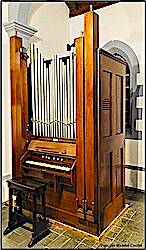
Master Degree Dissertation by UNICAMP, State University of Campinas, entitled “The eighteenth-century organ of the Carmo Church in Diamantina: its enigmas and its close connection with the Corregos organ”, defended in July 29, 2008, with Dr. Edmundo Hora as advisor.
Main Author: Handel Cecilio Pinto da Silva (Cecilio, Handel)
mestrado-description-o-orgao-setecentista-da-igreja-do-carmo-de-diamantina-seus-enigmas-e-sua-estreita-ligABSTRACT
The Pipe Organ of the Third Order of Carmo in Diamantina municipality, Brazil, has been a mystery to both Pipe Organ builders and organists, being the major concern determining the style of such a Pipe Organ (i.e., whether it belongs or not to the Iberian style of Pipe Organ building). Against this background, this thesis first aimed at shedding light on the identity of the Pipe Organ of the Third Order of Carmo in Diamantina municipality, Brazil, by means of technical and historical survey. Additionally, it also aimed at understanding some issues related to the Diapason (fonic basis) of the Carmo Pipe Organ, the verification whether it is an Pipe Organ with Divided Stops, the Compass and division of the Manual, the location of the former and the current Wind Supply, the Mechanisms of the current Wind Supply, and whether all the current Pipes are original. Advances in research, however, pointed to some links to an Pipe Organ located in Córregos municipality, particularly as a result of the analysis of documents registering the restoration carried out in the Carmo Pipe Organ in 1940. This raised the hypothesis that some Pipes in the Carmo Pipe Organ had been replaced with Pipes from the Córregos Pipe Organ. In the face of the lack of references to both Pipe Organs under scrutiny and also to the Brazilian colonial Pipe Organ building, the answer to such a hypothesis demanded a large bibliographic research focusing on documents related to both Pipe Organs and their Pipe Organ builders, as well as a trip to Portugal (Braga region) and several historical municipalities in Minas Gerais State (i.e., from Serro municipality, in Minas Gerais State, to Rio de Janeiro municipality, in Rio de Janeiro State, Brazil), tracking back the itinerary of cities where Lobo Mesquita, the first Organist of the Carmo Pipe Organ, performed. The inception of this research consisted of finding references to and within the Portuguese Pipe Organ building, because of the historical tradition of Pipe Organ building in Colonial Brazil and also because the Pipe Organ was built by a Portuguese catholic priest, Padre Manuel de Almeida e Silva. Historical data on the Carmo Pipe Organ and its Pipe Organ builder were collected from books of both the Order of Carmo and the Mother Church of Santo Antonio in Diamantina municipality. Further, both the Carmo Pipe Organ and the Córregos Pipe Organ themselves constituted important documents resorted to find answers to several questions about the Carmo Pipe Organ. Moreover, the analysis of several documents related to the 1940 restoration, alongside a bibliography concerning the Brazilian and the socalled Minas Gerais Captaincy’s musicology, Pipe Organ building, and history, also provided remarkable insights to this study. The result of this research accounts for a better understanding of the colonial Pipe Organ building in the former Minas Gerais Captaincy, primarily as a result of a pairwise comparison between the abovementioned instruments. Bearing in mind that every document about these instruments available up to date have been checked and revisited, the result can be fairly regarded insightful. Particularly as for the Carmo Pipe Organ, this study points out that it holds features typical of the Iberian style of Pipe Organ building, though carrying some influences of the Italian style, the Diapason is 6′ (FF Compass / Principal 6′), a Compass of 61 Notes: FF – f′′′, with Manual divided at b2 / c′3, even though it is not an Pipe Organ with Divided Stops; and the Wind Supply is a “Reservoir and FeederBellows”; besides, this Pipe Organ probably has some Pipes removed from the Córregos Pipe Organ.
Keywords: Brazilian colonial Pipe Organ building, Pipe Organs, Minas Gerais Captaincy.
http://bdtd.ibict.br/vufind/Record/UNICAMP-30_e40d916d80816afc7e79407a736134b1