

From Cabral to the Monasterie
Campinas, 14 a 27 de abril de 2014
ISABEL GARDENAL bel@unicamp.br
Ctesebius of Alexandria was the first to attach a set of flutes to a mechanism whose notes were driven by levers, and the air for the flutes was produced by a hydraulic bellows. Thus was born the pipe organ, the oldest of the keyboard instruments, in 246 BC.
Whether to accompany Gregorian chant, polyphonic chant or Protestant congregational hymns, the pipe organ has always had a place in the solemnities of the Catholic and Reformed Churches. It was an element of worship and for many years the only instrument allowed in liturgies.
Little has been published about the history of the organ in Brazil and its functioning. There were also doubts as to whether the country had an organ tradition. Although many scholars argue that it does not, Handel Cecilio, a doctoral student, concluded in his doctoral thesis that there was an organ tradition in Brazil. The research, from the Institute of Arts (IA), was supervised by professor Helena Jank.
Much of the doubt about the Brazilian tradition is justified by the need to consider the historical, religious, geographical, social, urban and economic context of each century of Brazil’s history, says the organist and musicologist.
In the first centuries, churches were few. So there was no way to compare Brazil with countries in Europe – a continent that already had organs since 660 A.D. “You cannot compare quantity with European churches that have at least one organ. The convent of Mafra, Portugal, alone has six organs,” he argues.
In addition, Brazilian colonization took place at first on the coast. Then it moved into the continent. As a result, there were many geographical difficulties that made the transportation of the organ more expensive.
With the discovery of gold in the Captaincy of Minas Gerais in the early 18th century, Vila Rica became the richest city in the world: “the New York of the time”. However, to import a product, bringing it from the coast to Vila Rica, took at least three months. Imagine carrying an organ up and down mountains on the back of a mule! These difficulties encouraged the emergence of master organ builders, the organeiros, in this Captaincy.
The genesis of organ building in Brazil occurred in the mid-18th century, through the teaching of trades. The master passed on what he learned to his disciple. The great examples were Agostinho Rodrigues Leite and his son Salvador, who learned the trade from his father and continued with excellence in the activity.
Organs were introduced into the Church around 660 AD, but were adopted for accompaniment in the period between the 9th and 10th centuries. In the Catholic tradition, Gregorian chant began a little earlier, in the 5th century.
The beginning of the 16th century marked a turning point in the history of the pipe organ with the Protestant Reformation – fertile ground for congregational singing, with hymns and the solo organ. Soon the need was felt to expand the instrument. New keyboards were added, and they grew in size. The Catholic Church, with the Counter Reformation, followed the same trend.
At the Council of Trent, between 1545 and 1563, it was postulated that the pipe organ would be the instrument par excellence. The news was welcomed, and the organ took on a new shape and dimension, becoming official in the Roman Catholic Church.
Research
Handel Cecilio had in common with the Baroque composer G. F. Handel a taste for organs. This led him to address in his thesis the organ art in the country between the colonial and imperial periods.
He sought to scrutinize the Benedictine monasteries, since it was the Order that most preserved the organ as the only instrument in its divine offices, since the foundation of the Brazilian monasteries.
One of the aims of his work was to find the initial milestone in the history of the organ in Brazil and thus determine who was the first Brazilian organist.
The first moment studied was the arrival of Cabral’s squadron in Brazil, which brought a Franciscan friar organist, Masseu, and a portable organ. Due to the connection that the Portuguese had with the Catholic Church, sailors always took religious people on their ships.
By analyzing documents and chronicles of the time, we sought to prove the role of Friar Masseu in the first masses in Brazil. This Italian friar accompanied several moments of Cabral’s voyage, and Handel accompanied them to prove or disprove the idea that he was the first organist. The final position was that he did not play at the masses celebrated in Brazil, because there were no supporting documents, to the displeasure of organists, musicologists and historians.
It is certain that the squadron had an organ and organist because, according to the chronicles, in the continuation of the voyage there were reports of celebrations with the pipe organ and there was talk of Masseus. In Brazil, however, not even Cabral’s letter commented on this episode, although its presence in the first masses of the Discovery is proven.
Benedictines
The final part of the thesis deals with the organ art in Benedictine monasteries, exemplifying this tradition. The monasteries have faced ups and downs. Some of them closed (Paraíba, Graça and Brotas, both in Bahia). The way was to recover them in the documentation.
However, since the closure of the novitiates (formation of religious preceding the taking of vows) by the Marquis of Pombal in the 18th century, until the end of the 20th century, their offices and the use of the organ were maintained.
The monastery of Olinda survived with a very old monk, who dreamed of the opening of the novitiates. Some accounts have pointed out that he waited every day for years for the German monks to arrive. When he saw them approaching, it was a moment of great emotion. The restoration of the Benedictine monasteries began.
Handel made the first case study on the organ of the Monastery of São Bento in Rio de Janeiro (RJ), built in 1773, one of the main organs representing Brazilian colonial organbuilding, the work of Agostinho Leite. According to period chronicles, it was a low-cost pipe organ for the value and quality it possessed.
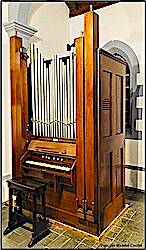
This instrument revealed interesting construction techniques. An order receipt for a portable realejo organ also showed the characteristics of this type of instrument in the 18th century, information that was unknown at the time.
For the Benedictine monks, “the dignity of worship depended on how they sang the cantata (Gregorian chant) and the pipe organ for accompaniment”.
Organist and musicologist
Since his master’s degree, Handel has dedicated himself to the study of organs, organists and organ builders of the colonial and imperial periods. The only way to promote historical recovery was through ecclesiastical documentation and period chronicles.
To this end, he went to the monasteries of Rio de Janeiro, Bahia, Olinda, Recife and the cities of São Paulo and Vinhedo, the former monastery of Santos; and to various archives in Portugal (Torre do Tombo, Braga District Archive, Coimbra University Archive), as well as visiting the monastery of Tibães (mother house of the Brazilian monasteries).
Many documents in Brazil and Portugal have been lost, making it difficult to rescue and build the history of the organ in the country. In Recife, to give you an idea, a member of one of the Third Orders managed to collect all their record books and kept them in a church. It’s just that the Orders were throwing them into the river Capibaribe. Much of the history has been lost, or moth eaten, or lacked proper restoration.
The Benedictines, faithful custodians of their documentation in their own archives, were fundamental, and opened the doors to Handel for research in the monasteries.
The monasteries of Rio de Janeiro, Olinda, Salvador and Vinhedo received the researcher in their hostels. In some of them, he was invited to have meals in the cloister, in distinction to the guest.
Much of this openness was due to a letter from Dom Luís de Orleans e Bragança, crown prince of the Brazilian imperial family. Handel, attached to the Monarchy, asked the prince for this presentation to the monasteries. Dom Luís wrote a letter in his own hand, not to mention the encouragement of Princes Dom Antônio and Dom Bertrand.
With this, it was possible to recover the history since its foundation and what there was about the organistic art, such as the pipe organs, the organists of this Order and the organbuilders.
Work
Handel examined thousands of documents. First of all, he had to find out in which archive or church the necessary documents were to be found. Even if they were inventoried, it was necessary to consult historical books and extensive documents to find out where a small piece of information might be.
Another obstacle was reading old documents. He had to learn paleography, which studies ancient and medieval manuscript texts. In Brazil, courses usually last 15 days or a semester, and few schools offer intensive courses.
Coming across an 18th-century document in the master’s program was daunting for Handel. That’s when he turned to the person in charge of the Sabará (MG) archive. “She opened the document on the computer. She read it and I followed along. The old handwriting became clear.”
The researcher continued reading ancient texts as a self-taught student, with the help of a scarce bibliography.
At the University of Coimbra, Portugal, where he went to continue his documentary research with a Capes scholarship, Handel learned that there would be two semesters of Paleography and Diplomacy, which deals with the reading and study of ancient documents. The professor of these disciplines, Maria do Rosário Barbosa Morujão, became his foreign co-supervisor.
She focused on the 16th and 17th centuries [the most difficult readings], passing through the 18th and 19th [easier readings]. “Without paleography, I wouldn’t have done a third of what I did,” she admits. Other tools used were Portuguese and Brazilian historiography, as well as an intensive Latin course with Professor Anita Martins.0
Influence
Handel noted some gaps in Brazilian musicology. The 16th and 17th centuries, for example, are poorly researched, while the 18th and subsequent centuries are more studied.
Specifically regarding the history of Brazilian organ art, the genesis of organbuilding and organbuilding was not known. Until the mid-18th century, documents complain about the lack of organ builders, which is answered by analyzing Brazilian and Portuguese documents.
“Currently, we have Brazilian organ builders and many digital organs, but only about 24 historical organs have survived,” he says. The last one is that of the old Sé do RJ, the former royal chapel, which came from Portugal.
The researcher notes that the pipe organ is closely linked to the liturgy of Christian churches. There were rules stipulated since the Council of Trent for its use and systematized in 1600 in the Caeremoniale Episcoporum. At some Masses, it was obligatory. In Holy Week, it could not be played. Only on Alleluia Saturday, and with full registration.
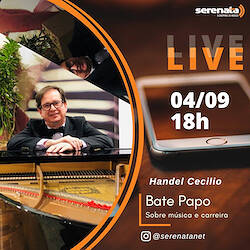
Handel performs in concerts in Brazil and abroad. In Spain, he composes the Duo Regia Symphonia Musicae with the trumpeter Basilio Gomarín Píres. He has also worked as an organist in Reformed churches since the age of ten. He studied piano, but chose the organ. His father was his first teacher and gave him the name of one of the most remarkable musicians of all time.
Article in PDF
DE-CABRAL-AOS-MOSTEIROS-TESE-DOUTORADO-UNICAMP-2014